

You have a fixed marketing budget and two ways to spend it. Pay for clicks now, or invest in visibility that may arrive in six months.
Most articles on this answer the question before asking it, usually in favour of whatever the author sells. The honest answer for a Gloucestershire SME is that the right choice depends on three things: how urgently you need enquiries, how competitive your sector is locally, and whether you can sustain spending for long enough to see a return.
SEO for SMEs is not automatically the better investment. It is the better investment under conditions worth being specific about.
SEO for SMEs in Gloucestershire: A Balanced Practical Guide
When paid search is the right answer
- You need enquiries this month. Paid search delivers visibility immediately. Organic work does not, and pretending otherwise wastes your time and money.
- You are testing something. A new service, a new area, a new audience. Paid search tells you within a fortnight whether demand exists, which is considerably cheaper than discovering it after six months of content.
- Your sector is seasonal. If you fit woodburners or do garden work, concentrated visibility at the right moment may beat year-round effort.
- Your margins support it. If a customer is worth several hundred pounds and you convert a reasonable share of enquiries, the arithmetic can work indefinitely.
When organic search is the right answer
- You are in it for years. Organic visibility compounds. Content published now keeps working, and the cost per enquiry falls over time rather than staying fixed.
- Your local market is not saturated. In much of Gloucestershire, particularly outside Cheltenham, competitors have not done the basic work. That gap is the strongest argument available and it will not stay open forever.
- Your customers research before buying. If people compare, read and consider before enquiring, being present throughout that process matters more than appearing at the moment of purchase intent.
- Your budget cannot sustain paid indefinitely. Paid visibility stops the day you stop paying. That is the whole trade-off in one sentence.
The comparison, honestly
Paid search is faster, more predictable and stops immediately when the budget does. You are renting attention, and the rent does not decrease.
Organic search is slower, less predictable and continues after you stop paying. You are building an asset, and assets take time to build.
Most SMEs that can afford both should run both, using paid to cover the gap while organic develops, then reducing paid spend as organic enquiries grow. That is unglamorous, and it is what tends to work.
What actually matters for a Gloucestershire SME
If you do commit to organic work, the order matters more than the effort.
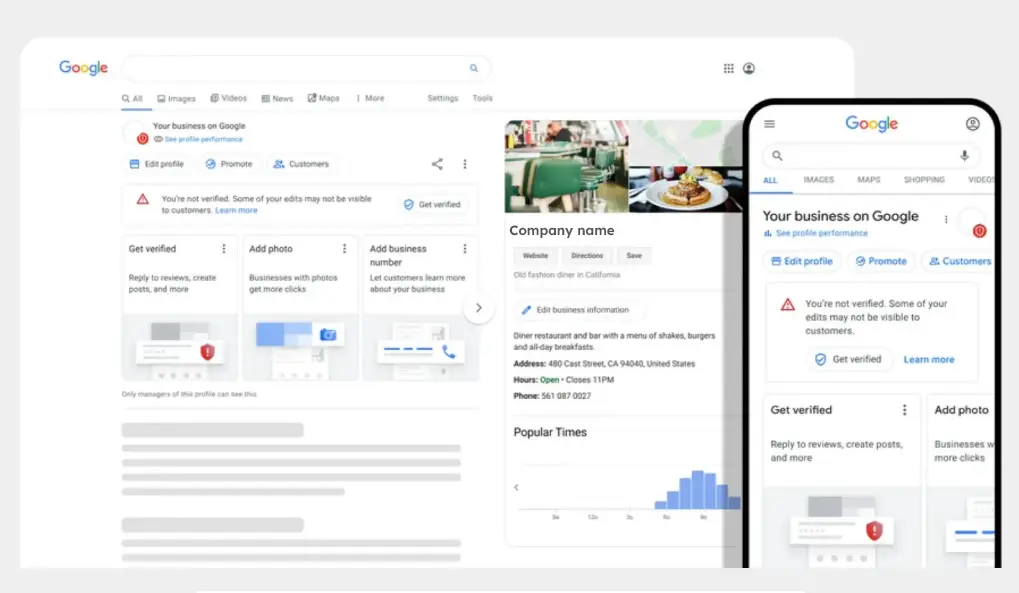
- Your Google Business Profile, completed properly. For local searches, it is frequently seen before your website and generates enquiries directly.
- A page for each service, in the words customers use. One page covering eight services will not compete with businesses that wrote eight.
- Consistent business details across your site, profile and every listing. Search your phone number to find the listings that misspell your name.
- Reviews, asked for when a job finishes well. That habit outperforms any automated sequence.
- A site that is fast on a phone. Local searches arrive on mobile data, frequently outdoors. Where performance and environmental impact both apply, treat them as the same lever: reducing unnecessary data transfer and processing supports a faster experience while lowering estimated digital carbon, though environmental figures remain modelled rather than directly measured.
Google’s SEO starter guide covers the fundamentals accurately and for free, which is worth reading before commissioning anyone.
Measuring it without fooling yourself
Track enquiries by source and ask new customers how they found you. At SME scale, this is more reliable than any attribution tool, because journeys cross devices and phone calls never touch your analytics.
Watch branded search volume, which shows recognition building and captures value that direct-visit attribution loses.
Be wary of ranking reports presented without enquiry data. Positions are easy to report and easy to select favourably, and nobody can guarantee them.
Our search engine optimisation work reports against enquiries, with the attribution gaps stated rather than smoothed over.